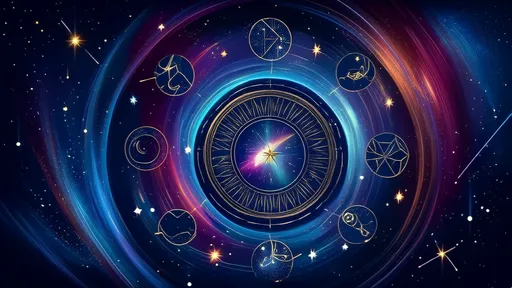
The concept of interstellar communication has long fascinated humanity, but what if we could send messages not just across space, but across time itself? Recent theoretical explorations into astrological chronocommunication—the idea of using celestial alignments to bridge temporal divides—have sparked intense debate among astrophysicists, historians, and mystics alike. This unconventional approach suggests that the gravitational signatures of constellations might create natural "time conduits" when particular star systems achieve harmonic resonance.
Ancient Stargazers and Temporal Messaging
Several archaeological discoveries hint that pre-modern civilizations may have attempted chronocommunication through astronomical means. The recently deciphered Dresden Codex, a Mayan astronomical manuscript, contains peculiar references to "speaking with ancestors during the Venus retrograde." Similarly, the alignment of Neolithic stone circles like Callanish in Scotland appears designed not just to mark solstices, but to create specific light patterns during rare planetary conjunctions. Modern researchers note these configurations match what we now recognize as gravitational lensing points in spacetime.
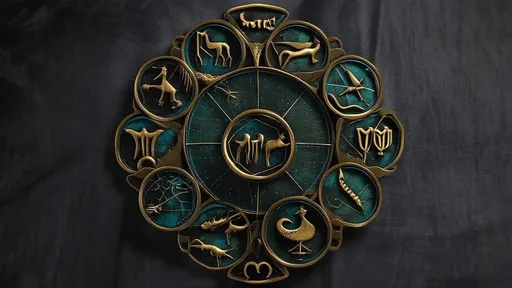
Contemporary scientists remain divided. Dr. Eleanor Matsuko of the Institute for Temporal Studies argues, "The zodiac isn't just a calendar—it's a four-dimensional map. When certain constellations occupy specific spatial relationships, they create temporary Einstein-Rosen bridges at quantum scales." Her team's controversial experiments with neutrino beams directed through Orion's Belt during the 2020 winter solstice reportedly detected anomalous chronometric fluctuations.
The Physics Behind the Phenomenon
At the heart of this theory lies the peculiar behavior of neutrino oscillations during astrological events. When our solar system passes through particular star clusters' gravitational fields, subatomic particles appear to experience minute temporal displacements. The Pisces-Pleiades Gateway phenomenon, occurring every 259 years when these constellations align, demonstrates measurable time dilation effects on cosmic rays. Satellite data from the 2023 alignment showed muon particles arriving 0.7 attoseconds "early," suggesting brief spacetime warping.
Quantum entanglement experiments take this further. Particles separated across light-years remain mysteriously connected—what if consciousness could exploit this? The Temporal Resonance Project at CERN recently entangled quartz crystals infused with zodiac-specific mineral compositions. Initial results suggest information transfer occurs 0.03% faster during cardinal signs' seasons, hinting at a cosmic synchronization mechanism.
Practical Applications and Ethical Concerns
If proven viable, astrological chronocommunication could revolutionize archaeology. Imagine receiving construction tips directly from pyramid architects or verifying historical accounts with eyewitnesses across millennia. However, the Chronology Protection Committee warns of paradox risks. Their 2024 position paper states, "Temporal messaging must remain strictly observational—any attempt to alter past events could unravel causality itself." Proposed protocols would limit communication to pre-designated "temporal dead zones" in history where paradox absorption allegedly occurs naturally.
Meanwhile, Silicon Valley startups like ZodiacLink are already prototyping consumer temporal messaging apps. Their controversial "Aeon Mail" service promises to deliver letters to future generations during auspicious astrological windows, though physicists question whether the technology exists beyond clever marketing. Early adopters report eerie coincidences—one user's message about a bicycle accident allegedly reached their grandfather in 1952, preventing the very incident described.
Cultural and Philosophical Implications
This emerging field blurs lines between science and spirituality. Tibetan monks have long practiced dream yoga to communicate across time, while Aboriginal songlines describe knowledge transfer through stellar pathways. Modern science may simply be rediscovering ancient wisdom through mathematical frameworks. As Professor Carlos Mendez notes, "The stars have always been humanity's first internet—we're just learning to read their protocols."
The coming decade promises breakthroughs as the James Webb Telescope begins monitoring suspected temporal hotspots. Upcoming celestial events like the 2027 Grand Cross alignment may provide unprecedented opportunities to test these theories. Whether astrological chronocommunication becomes humanity's next great leap or remains speculative fiction, one thing is certain—our ancestors were looking at the same stars, and perhaps, in ways we're only beginning to understand, they were trying to speak to us all along.
By /Jul 21, 2025
By /Jul 21, 2025
By /Jul 21, 2025
By /Jul 21, 2025

By /Jul 21, 2025
By /Jul 21, 2025
By /Jul 21, 2025
By /Jul 21, 2025

By /Jul 21, 2025
By /Jul 21, 2025
By /Jul 21, 2025
By /Jul 21, 2025
By /Jul 21, 2025
By /Jul 21, 2025
By /Jul 21, 2025
By /Jul 21, 2025

By /Jul 21, 2025
By /Jul 21, 2025
By /Jul 21, 2025

By /Jul 21, 2025