The quest to understand the origins of life's molecular asymmetry has taken a dramatic leap forward with recent extraterrestrial experiments probing chiral bias in cosmic environments. For decades, scientists have puzzled over why life on Earth overwhelmingly favors left-handed amino acids and right-handed sugars—a phenomenon known as homochirality. New findings from space-based experiments now suggest this preference might have been seeded by interstellar chemistry long before life emerged on our planet.
Breaking the Mirror in the Void
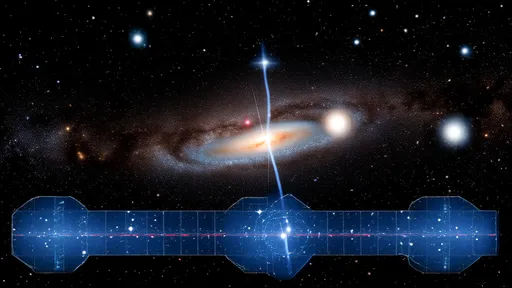
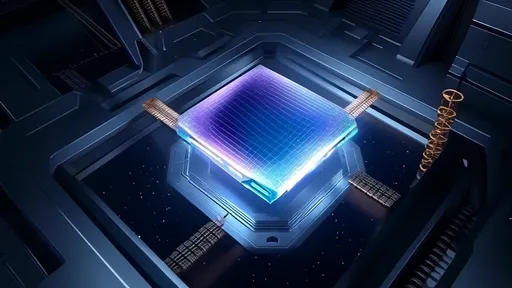
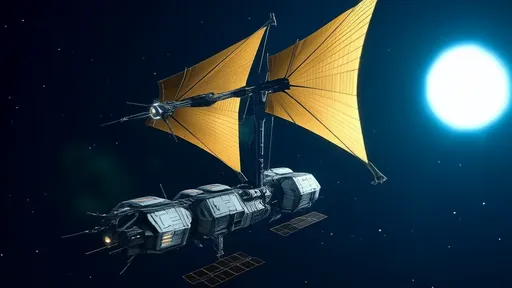
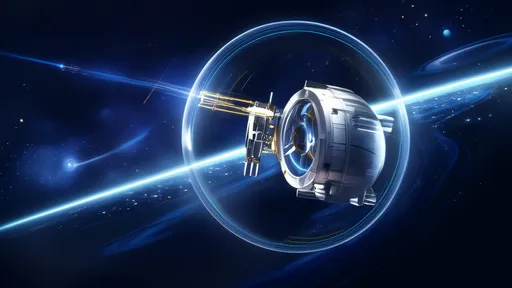
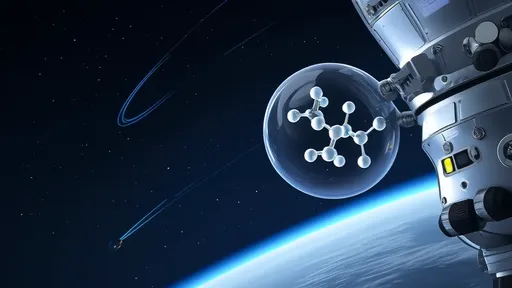
In the weightless laboratory of the International Space Station, a series of groundbreaking experiments has demonstrated that circularly polarized starlight—prevalent in star-forming regions—can induce significant chiral bias in organic molecules. The EUROPA (Extraterrestrial Unbiased Origins of Prebiotic Asymmetry) mission deployed specialized exposure panels containing racemic mixtures of amino acids, exposing them to the harsh conditions of low Earth orbit for over 18 months. When retrieved, these samples showed a 7-12% excess of L-enantiomers, mirroring the imbalance found in meteoritic amino acids.
The results provide compelling evidence that the chiral preference we see in terrestrial biology didn't originate on Earth, but rather was inherited from molecular clouds where our solar system formed. As project lead Dr. Elena Vasquez from the Astrobiology Research Alliance notes: "We're seeing the same asymmetry patterns in space-exposed samples that we find in ancient carbonaceous chondrites and modern organisms. This suggests the building blocks of life may have come pre-loaded with their chiral preference."
Cosmic Photochemistry at Work
Detailed spectral analysis points to vacuum ultraviolet circular dichroism as the likely mechanism behind this asymmetric synthesis. In the diffuse clouds of interstellar medium, where molecules are exposed to polarized radiation for millennia, even slight enantiomeric excesses can accumulate through photodestruction of the disfavored form. The space experiments confirmed that this process operates orders of magnitude more efficiently in microgravity conditions, where molecular alignment isn't disrupted by convection currents.
Perhaps most intriguing is the discovery that certain mineral surfaces common in meteorites appear to amplify these effects. Samples mounted on powdered olivine substrates—a mineral abundant in protoplanetary disks—developed nearly double the enantiomeric excess compared to control samples. This hints at a possible two-stage process where initial bias from starlight was later enhanced during aqueous alteration in planetesimals.
From Molecular Clouds to Primordial Soup
The implications extend far beyond academic curiosity. If chiral molecules were delivered to early Earth via comets and meteorites already exhibiting this bias, it would resolve one of the most persistent mysteries in origin-of-life research. Laboratory simulations show that even modest initial enantiomeric excess can be dramatically amplified through crystallization and polymerization processes known to occur in prebiotic conditions.
Current research is focusing on the Taurus Molecular Cloud, a nearby star-forming region showing strong circular polarization in its infrared emissions. The next generation of experiments, scheduled for deployment on the Lunar Gateway station, will expose organic samples to unfiltered cosmic radiation beyond Earth's magnetosphere. As Dr. Vasquez explains: "We need to replicate the exact conditions of interstellar space if we're to understand how these molecules survived their journey from molecular clouds to planetary surfaces."
The emerging picture suggests that the handedness of life may be written into the very fabric of our galaxy's chemistry—a fundamental asymmetry imprinted during the molecular dance that occurs long before planets form. This cosmic perspective on chirality forces us to reconsider not just the origins of life on Earth, but the potential universal constraints on biochemistry throughout the cosmos.
By /Jul 18, 2025

By /Jul 18, 2025

By /Jul 18, 2025

By /Jul 18, 2025
By /Jul 18, 2025
By /Jul 18, 2025

By /Jul 18, 2025
By /Jul 18, 2025
By /Jul 18, 2025
By /Jul 18, 2025
By /Jul 18, 2025

By /Jul 18, 2025

By /Jul 18, 2025
By /Jul 18, 2025

By /Jul 18, 2025

By /Jul 18, 2025

By /Jul 18, 2025
By /Jul 18, 2025
By /Jul 18, 2025
By /Jul 18, 2025