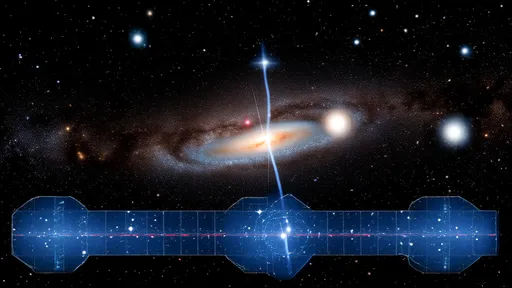
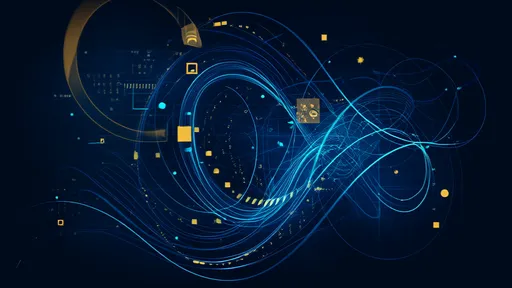
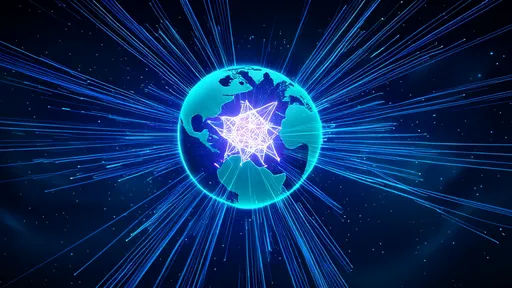
In a groundbreaking achievement that pushes the boundaries of quantum communication, an international consortium of physicists has unveiled the world's first quantum teleportation map. This revolutionary chart details the intricate web of quantum entanglement connections spanning across continents, marking a significant leap toward building a functional quantum internet. The map doesn't represent physical infrastructure like fiber-optic cables, but rather the invisible threads of quantum correlation that could form the backbone of tomorrow's unhackable communication networks.
The project, dubbed Quantum Atlas, combines data from twelve quantum laboratories across North America, Europe, and Asia. What makes this development extraordinary isn't just the technical achievement of mapping quantum connections, but the revelation that these entanglement pathways naturally form complex, self-organizing patterns resembling neural networks. Dr. Elara Mikkelsen, lead researcher at the Copenhagen Quantum Institute, describes it as "discovering the vascular system of quantum reality" – a hidden architecture that has existed all along, waiting to be charted.
Quantum teleportation, contrary to science fiction portrayals, doesn't involve physically transporting matter. Instead, it's the instantaneous transfer of quantum states between entangled particles regardless of distance. The newly published map reveals that certain geographical locations appear to function as natural quantum hubs, where entanglement connections are denser and more stable. Surprisingly, these hubs don't always align with major population centers or existing internet exchange points, suggesting that quantum networks may follow entirely different organizational principles than classical communication systems.
One of the most startling findings is what researchers are calling "quantum weather patterns" – fluctuations in entanglement quality that appear to follow diurnal cycles and are influenced by environmental factors. The team detected stronger quantum connections during specific hours, with patterns varying between locations. This discovery implies that future quantum networks might need to account for temporal variations in connection quality, much like sailors adjusting to shifting winds.
The mapping effort required developing entirely new measurement protocols. Traditional network mapping tools proved useless for quantum systems, as the act of measurement inherently alters quantum states. Researchers overcame this through a clever combination of indirect measurement techniques and quantum error correction algorithms. Professor Rajiv Chaudhary from the Mumbai Quantum Computing Center compares the process to "mapping a room by only listening to echoes, without ever shining a light or touching the walls."
Practical applications of this quantum map are already emerging. Several financial institutions have expressed interest in using the data to optimize their quantum-secured communication lines. More intriguingly, the European Space Agency is investigating whether the map could help identify optimal locations for future quantum satellite ground stations. The natural quantum hubs might offer advantages for maintaining entanglement with orbiting quantum nodes.
Beyond immediate applications, the map raises profound questions about the nature of quantum connections. The emergent patterns challenge several existing theories about how entanglement propagates through space-time. Some theorists speculate that we might be glimpsing a deeper layer of physical reality, where information follows different pathways than matter and energy. As the research team prepares to expand their mapping efforts to include quantum memory nodes and superconducting quantum processors, one thing becomes clear: we're just beginning to navigate the extraordinary geography of the quantum world.
The publication of this quantum teleportation map represents more than a scientific milestone—it's the first atlas of a landscape we're only starting to comprehend. As quantum networks evolve from laboratory experiments to global infrastructure, this map will likely be remembered as the Rosetta Stone that helped translate quantum phenomena into practical engineering. The next phase of research will focus on dynamic mapping, capturing how these quantum connections evolve in real-time, potentially revealing an even more astonishing picture of our quantum interconnectedness.
By /Jul 18, 2025
By /Jul 18, 2025

By /Jul 18, 2025
By /Jul 18, 2025
By /Jul 18, 2025
By /Jul 18, 2025
By /Jul 18, 2025
By /Jul 18, 2025
By /Jul 18, 2025
By /Jul 18, 2025
By /Jul 18, 2025
By /Jul 18, 2025
By /Jul 18, 2025
By /Jul 18, 2025
By /Jul 18, 2025
By /Jul 18, 2025
By /Jul 18, 2025
By /Jul 18, 2025
By /Jul 18, 2025
By /Jul 18, 2025