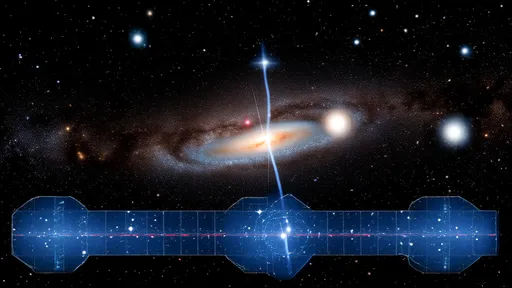
The Milky Way, our cosmic home, is not the pristine, isolated galaxy it might appear to be. Through the lens of galactic archaeology, scientists are uncovering a violent and dynamic history written in the chemical fingerprints of its stars. The emerging field of stellar metallicity mapping has revealed that our galaxy bears the scars of ancient collisions—mergers with smaller galaxies that have fundamentally shaped its structure and stellar populations.
Stellar Fossils and the Chemical Record
Stars are more than just twinkling points of light; they are time capsules. Formed from the gas and dust of their galactic environment, each star carries a chemical signature—a record of the elements present in its birthplace. Heavier elements, or metals in astronomical terms, are forged in the hearts of stars and scattered across the galaxy through supernovae and stellar winds. By measuring the metal content of stars across the Milky Way, astronomers can trace the history of star formation and the assembly of our galaxy.
Recent large-scale surveys, such as Gaia and APOGEE, have provided unprecedented data on the positions, motions, and chemical compositions of millions of stars. These observations reveal distinct stellar populations with varying metallicities, each telling a different chapter of the Milky Way’s past. The oldest stars, found in the halo and thick disk, are metal-poor, reflecting the primordial conditions of the early universe. In contrast, younger stars in the thin disk are richer in metals, a testament to the progressive enrichment of the interstellar medium over billions of years.
The Ghosts of Mergers Past
One of the most striking revelations from galactic archaeology is the evidence of past mergers. The Milky Way has grown not just by forming stars but by cannibalizing smaller galaxies. These cosmic collisions leave behind debris—streams of stars with distinct chemical and kinematic properties. One of the most famous examples is the Gaia-Enceladus-Sausage (GES) merger, a dwarf galaxy that collided with the Milky Way around 10 billion years ago. Stars from this event are scattered throughout the halo, their low metallicity and peculiar orbits betraying their extragalactic origin.
Another significant merger is the Sagittarius dwarf galaxy, which is currently being torn apart by the Milky Way’s gravity. Its stars form vast, looping streams around our galaxy, their chemical makeup distinct from the native Milky Way population. These mergers are not just historical footnotes; they have injected new stars and gas into the Milky Way, triggering bursts of star formation and altering the galactic structure.
Deciphering the Merger Timeline
By combining stellar ages, metallicities, and orbital dynamics, astronomers are reconstructing the sequence of these mergers. Metal-poor stars in the halo suggest early, chaotic periods of accretion, while younger, more metal-rich populations in the disk indicate a quieter phase of gradual growth. The chemical diversity among halo stars points to multiple progenitor galaxies, each contributing its own unique stellar population.
One of the challenges in this work is untangling overlapping merger events. The Milky Way’s history is a palimpsest—later mergers overwrite the evidence of earlier ones. However, advances in computational modeling and machine learning are allowing researchers to isolate these signals, revealing a far more complex assembly history than previously imagined.
Implications for Galaxy Formation
The study of the Milky Way’s merger history is not just about understanding our own galaxy. It provides a testbed for theories of galaxy formation in general. The hierarchical model predicts that galaxies grow through mergers, but the details—how often they occur, how they affect star formation, and how they shape galactic structure—are still being refined. The Milky Way’s archaeological record offers a unique opportunity to study these processes up close.
Moreover, these findings have profound implications for the search for dark matter. Mergers disturb the distribution of this invisible substance, and by studying the kinematics of accreted stars, astronomers can map the gravitational influence of dark matter in our galaxy. This, in turn, helps constrain the properties of dark matter particles, one of the biggest mysteries in modern physics.
The Future of Galactic Archaeology
The next decade promises even greater advances in this field. Upcoming missions like the James Webb Space Telescope (JWST) and the European Space Agency’s PLATO will provide deeper insights into the chemical composition and ages of stars. Meanwhile, ground-based surveys like the Legacy Survey of Space and Time (LSST) at the Vera C. Rubin Observatory will map billions of stars, uncovering fainter and more distant remnants of past mergers.
As the data flood in, galactic archaeologists will continue to piece together the Milky Way’s tumultuous past. Each star is a clue, and together, they tell the story of a galaxy built not in isolation, but through a series of cosmic encounters that have shaped its destiny. The Milky Way’s history is written in metal, and we are only just beginning to read it.
By /Jul 18, 2025

By /Jul 18, 2025

By /Jul 18, 2025

By /Jul 18, 2025

By /Jul 18, 2025

By /Jul 18, 2025

By /Jul 18, 2025
By /Jul 18, 2025

By /Jul 18, 2025
By /Jul 18, 2025

By /Jul 18, 2025

By /Jul 18, 2025
By /Jul 18, 2025

By /Jul 18, 2025

By /Jul 18, 2025

By /Jul 18, 2025

By /Jul 18, 2025
By /Jul 18, 2025

By /Jul 18, 2025
By /Jul 18, 2025