Lunar Lava Tube Cities: Natural Space Habitats with Radiation Shielding

Jul 18, 2025 By

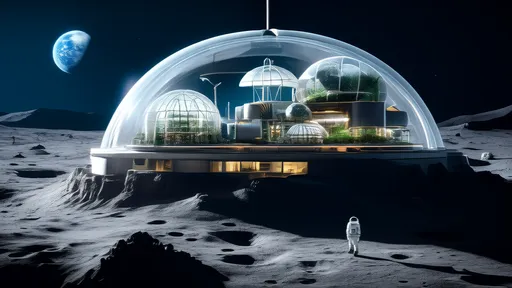
In humanity's relentless pursuit of becoming an interplanetary species, the Moon has emerged as the most logical first step for establishing a permanent off-world presence. While numerous challenges exist in creating habitable environments on the lunar surface, nature may have already provided one of the most elegant solutions – lunar lava tubes. These remarkable geological formations could serve as ready-made cosmic bunkers, offering unparalleled protection from the harsh realities of space while dramatically reducing construction costs for future lunar settlements.

The concept isn't as far-fetched as it might initially appear. Lunar lava tubes are natural tunnels formed by ancient volcanic activity, where the surface of a lava flow cooled and solidified while molten rock continued flowing beneath, eventually draining away to leave hollow cavities. On Earth, similar formations exist in volcanic regions like Hawaii and Iceland, though they're significantly smaller than their lunar counterparts. What makes these structures particularly exciting for space architects is their sheer scale – lunar lava tubes are estimated to be hundreds of times larger than those on Earth, with some potentially reaching up to several kilometers in diameter.

Radiation protection stands as perhaps the most compelling advantage of building within these subterranean spaces. The Moon lacks both an atmosphere and a magnetic field, leaving its surface exposed to deadly cosmic rays and solar radiation. A human spending just a few days on the lunar surface would receive radiation doses exceeding annual limits for radiation workers on Earth. The roof of a lava tube, typically tens of meters thick, could provide shielding equivalent to Earth's atmosphere, reducing radiation exposure to safe levels without requiring massive amounts of imported shielding material.

Temperature regulation presents another significant benefit. Lunar surface temperatures swing violently between extremes, from 127°C (260°F) during the day to -173°C (-280°F) at night. These fluctuations make surface habitats energy-intensive to maintain. Inside lava tubes, temperatures remain remarkably stable, hovering around -20°C (-4°F) – still cold by human standards, but far easier and more energy-efficient to manage than surface conditions. This thermal stability could prove crucial for long-term habitat viability and agricultural operations.

Micrometeorite protection completes the trifecta of natural advantages offered by these formations. The lunar surface is constantly bombarded by tiny space rocks traveling at tremendous speeds. While individual impacts are small, their cumulative effect poses serious risks to surface structures. Lava tube ceilings provide excellent protection against these microscopic projectiles, potentially saving future colonies from catastrophic decompression events that could plague surface domes or other exposed structures.

Recent orbital observations have dramatically increased scientific interest in these formations. High-resolution images from spacecraft like NASA's Lunar Reconnaissance Orbiter have revealed numerous "skylights" – collapsed sections of lava tubes that provide visible access to the caverns beneath. Some of these openings measure hundreds of feet across, suggesting truly enormous voids below. Radar data has further confirmed the existence of extensive tunnel networks in certain lunar regions, particularly under the ancient volcanic plains known as maria.

The potential scale of these underground spaces boggles the imagination. Conservative estimates suggest some lunar lava tubes could enclose volumes equivalent to small terrestrial cities. This changes the paradigm for lunar colonization – instead of building cramped, pressurized surface habitats, we might instead pressurize these existing caverns, creating spacious underground environments where residents could move about relatively freely without spacesuits. The psychological benefits of such spacious living conditions cannot be overstated for long-duration missions.

Engineering challenges certainly remain before these natural structures can be made habitable. While the tubes themselves are structurally sound – lunar rock is exceptionally strong due to the absence of water erosion and other weathering processes – creating airtight seals at entrances and developing methods to reinforce weak sections will require innovative solutions. Some proposals suggest using inflatable structures within the tubes rather than attempting to pressurize the entire cavern, combining the benefits of natural shielding with more manageable engineering scales.

Resource availability near potential lava tube sites adds another layer of practicality. Many lava tubes are located in or near the lunar maria, which contain relatively flat terrain ideal for landing spacecraft and operating surface vehicles. These regions also tend to be rich in resources like ilmenite, a mineral that could be processed to extract oxygen and other useful materials. The presence of possible water ice in permanently shadowed regions near some lava tube locations could solve another critical resource challenge.

The implications for long-term lunar development are profound. A successfully established lava tube settlement could evolve from a small scientific outpost to a thriving community with hundreds or even thousands of residents. The protected environment would allow for expansive agriculture using artificial lighting, manufacturing facilities, and even recreational spaces unimaginable in cramped surface habitats. Such a settlement could serve as a proving ground for technologies needed for more ambitious Mars colonization efforts while providing economic value through research, tourism, and possibly resource extraction.

International interest in lunar lava tube habitation is growing rapidly. Both NASA and ESA have funded studies examining the feasibility of using these formations for future bases. Private space companies have also shown interest, recognizing the potential cost savings compared to building entirely artificial structures. Some experts suggest that lava tube settlements could become reality within the next two to three decades, especially if current momentum in lunar exploration continues to build.

As with any pioneering endeavor, ethical and legal questions arise. Who would have rights to these natural structures? How would we preserve their scientific value while developing them for human use? The international community will need to address these issues as the technology to utilize lava tubes matures. What's clear is that these remarkable geological features represent one of the most promising pathways to establishing a permanent human presence beyond Earth – a chance to live within the Moon rather than simply on it.

The dream of lunar cities no longer belongs solely to the realm of science fiction. Through the creative utilization of nature's own architecture, humanity may soon take its first steps toward becoming a truly spacefaring civilization. Lunar lava tubes offer a rare combination of practical advantages and inspirational possibilities, making them perhaps the ideal locations for our first off-world homes. As exploration continues and technology advances, these hidden lunar caverns may well become the cradle of humanity's extraterrestrial future.
Recommend Posts
Science

Galactic Archaeology Atlas: Star Merger History Revealed by Stellar Metallicity

By /Jul 18, 2025

The Milky Way, our cosmic home, is not the pristine, isolated galaxy it might appear to be. Through the lens of galactic archaeology, scientists are uncovering a violent and dynamic history written in the chemical fingerprints of its stars. The emerging field of stellar metallicity mapping has revealed that our galaxy bears the scars of ancient collisions—mergers with smaller galaxies that have fundamentally shaped its structure and stellar populations.
Science

Eye Tracking: Early Screening for Neurodegenerative Diseases

By /Jul 18, 2025

In the relentless pursuit of early diagnostic tools for neurodegenerative diseases, researchers are turning their attention to an unexpected yet revealing indicator: eye movements. Recent advancements in eye-tracking technology have unveiled its potential to detect subtle neurological changes long before traditional symptoms manifest. This non-invasive approach could revolutionize how we identify conditions like Alzheimer’s, Parkinson’s, and Huntington’s disease, offering hope for earlier interventions and better patient outcomes.
Science

Automatic Analysis of Fecal Microbiome in Smart Toilets

By /Jul 18, 2025

The integration of smart technology into everyday household items has reached a new frontier with the emergence of intelligent toilets capable of analyzing fecal microbiota. These cutting-edge devices, once considered futuristic, are now making their way into modern bathrooms, offering users unprecedented insights into their gut health. The convergence of sanitation and biotechnology represents a significant leap forward in personalized healthcare, transforming a routine bodily function into a valuable diagnostic opportunity.
Science

Diamond Quantum Sensor: In Vivo Monitoring of Nanoscale Brain Magnetic Fields

By /Jul 18, 2025

In a groundbreaking development that could revolutionize neuroscience and medical diagnostics, researchers have successfully demonstrated the use of diamond quantum sensors for real-time, nanoscale monitoring of magnetic fields in living brains. This cutting-edge technology promises to unlock unprecedented insights into neural activity at resolutions previously thought impossible.
Science

Topological Photonics: The Path to Chip-based Photonic Quantum Computing

By /Jul 18, 2025

The race to build practical quantum computers has entered a fascinating new phase where photonic technologies intersect with topological physics. Researchers worldwide are now exploring how topological photonics could provide the missing link for creating scalable, fault-tolerant quantum photonic chips - potentially solving some of the most stubborn challenges in optical quantum information processing.
Science

Phonon Qubits: Superconducting Control of Silicon Crystal Vibrations

By /Jul 18, 2025

In a groundbreaking development that bridges the worlds of quantum computing and materials science, researchers have demonstrated unprecedented control over silicon crystal vibrations using superconducting circuits. This achievement opens new pathways for utilizing phonons—the quantum particles of sound and vibration—as stable carriers of quantum information. Unlike their photonic cousins, phonons interact strongly with their host material, offering tantalizing possibilities for compact quantum memory and transduction between different quantum systems.
Science

Sweat Health Patch: An E-Skin for Real-Time Metabolite Analysis

By /Jul 18, 2025

In a groundbreaking advancement for wearable health technology, researchers have developed an electronic skin (e-skin) patch capable of analyzing sweat to monitor metabolic markers in real time. This innovative device, thinner than a human hair and flexible enough to conform to the body's contours, represents a significant leap forward in personalized healthcare and continuous physiological monitoring.
Science

Neutrino Oscillations: Patching the Cracks in the Standard Model of Particle Physics

By /Jul 18, 2025

The discovery of neutrino oscillations has sent ripples through the foundations of particle physics, revealing the first unignorable crack in the otherwise remarkably successful Standard Model. What began as a puzzling anomaly in solar neutrino detection has blossomed into one of the most exciting frontiers in modern physics, forcing scientists to reconsider fundamental assumptions about the building blocks of our universe.
Science

Topological Quantum Memory: Nine-Dimensional Encoding for Interference-Resistant Information Storage

By /Jul 18, 2025

In the rapidly evolving field of quantum computing, researchers are constantly pushing the boundaries of what’s possible in information storage and processing. One of the most groundbreaking developments in recent years is the advent of topological quantum memory, a revolutionary approach that leverages nine-dimensional encoding to create robust, error-resistant storage systems. Unlike traditional quantum memory, which is highly susceptible to environmental interference, this new paradigm offers unprecedented stability by exploiting the mathematical properties of higher-dimensional spaces.
Science

Solar Sail Interstellar Express: Light Pressure-Driven Deep Space Cargo Transportation

By /Jul 18, 2025

In the vast, silent expanse of space, a quiet revolution is underway. The concept of solar sails—once confined to the pages of science fiction—is now emerging as a viable solution for interstellar cargo transport. Unlike traditional propulsion systems that rely on chemical fuels or ion thrusters, solar sails harness the subtle but constant pressure of sunlight to navigate the cosmos. This technology promises to redefine how humanity ships goods across the solar system and beyond, offering a sustainable and cost-effective alternative for deep-space logistics.
Science

Gravitational Wave Calibration: A New Measure for the Expansion Rate of the Universe

By /Jul 18, 2025

The cosmos has long been measured by the flicker of distant stars and the redshift of galaxies, but a groundbreaking approach is rewriting the rules of cosmic cartography. By harnessing the faint ripples of gravitational waves, scientists are now refining the Hubble constant—the rate at which the universe expands—with unprecedented precision. This method sidesteps decades of astronomical disputes, offering a fresh lens to scrutinize one of cosmology’s most enduring puzzles.
Science

Turbulence Prediction Algorithms: Taming Chaotic Systems with Machine Learning

By /Jul 18, 2025

The realm of turbulence prediction has long been a frontier where physics meets computational impossibility. For decades, scientists have grappled with the chaotic nature of turbulent flows—those swirling, unpredictable patterns that govern everything from weather systems to jet engine efficiency. Traditional approaches, rooted in Navier-Stokes equations, often buckle under the sheer computational weight required to model these systems accurately. But now, a seismic shift is underway as machine learning begins to tame the chaos.
Science

Exoplanetary Volcanic Activity: Thermal Imaging Evidence of Silicate Clouds

By /Jul 18, 2025

Astronomers have long speculated about the existence of volcanic activity on exoplanets, but direct evidence has remained elusive—until now. A groundbreaking study using thermal imaging has revealed the presence of silicate clouds on a distant rocky world, providing the strongest indication yet of active volcanism beyond our solar system. The findings, published in The Astrophysical Journal Letters, could reshape our understanding of planetary evolution and the potential for habitability in extreme environments.
Science

Quantum Entanglement Network: The World's First Map of Quantum Teleportation

By /Jul 18, 2025

In a groundbreaking achievement that pushes the boundaries of quantum communication, an international consortium of physicists has unveiled the world's first quantum teleportation map. This revolutionary chart details the intricate web of quantum entanglement connections spanning across continents, marking a significant leap toward building a functional quantum internet. The map doesn't represent physical infrastructure like fiber-optic cables, but rather the invisible threads of quantum correlation that could form the backbone of tomorrow's unhackable communication networks.
Science

Lunar Lava Tube Cities: Natural Space Habitats with Radiation Shielding

By /Jul 18, 2025

In humanity's relentless pursuit of becoming an interplanetary species, the Moon has emerged as the most logical first step for establishing a permanent off-world presence. While numerous challenges exist in creating habitable environments on the lunar surface, nature may have already provided one of the most elegant solutions – lunar lava tubes. These remarkable geological formations could serve as ready-made cosmic bunkers, offering unparalleled protection from the harsh realities of space while dramatically reducing construction costs for future lunar settlements.
Science

Sleep Sound Wave Device: Inducing Synchronous Deep Sleep Phases

By /Jul 18, 2025

The realm of sleep science has witnessed a groundbreaking advancement with the emergence of sleep soundwave technology, particularly in the domain of deep sleep phase synchronization. This innovative approach leverages the power of acoustic stimulation to enhance the quality of deep sleep, a critical phase for physical restoration and cognitive function. Researchers and sleep experts are now exploring how precisely calibrated soundwaves can synchronize brainwave patterns, ushering in a new era of sleep optimization.
Science

Respiratory Diagnostic Device: Nanosensing Detection of Lung Cancer Biomarkers

By /Jul 18, 2025

The field of medical diagnostics is witnessing a revolutionary shift with the advent of nanotechnology, particularly in the detection of lung cancer biomarkers. Traditional methods for diagnosing lung cancer often involve invasive procedures, delayed results, and limited sensitivity. However, the integration of nanosensors into respiratory diagnostic devices is paving the way for non-invasive, real-time, and highly accurate detection of lung cancer markers. This breakthrough promises to transform early diagnosis and improve patient outcomes.
Science

Asteroid Magnetic Mapping: Magnetofossils of Primitive Solar System Debris

By /Jul 18, 2025

The study of asteroid magnetic fields has opened a new window into understanding the early solar system. These ancient remnants, often considered cosmic rubble, carry within them magnetic imprints that tell a story billions of years old. Scientists are now using advanced techniques to map these fields, revealing clues about the formation and evolution of our planetary neighborhood.
Science

Chirality Origin Experiment: Verification of Biased Synthesis in Outer Space

By /Jul 18, 2025

The quest to understand the origins of life's molecular asymmetry has taken a dramatic leap forward with recent extraterrestrial experiments probing chiral bias in cosmic environments. For decades, scientists have puzzled over why life on Earth overwhelmingly favors left-handed amino acids and right-handed sugars—a phenomenon known as homochirality. New findings from space-based experiments now suggest this preference might have been seeded by interstellar chemistry long before life emerged on our planet.
Science

Cold Atom Interferometer: A Mobile Laboratory for Measuring Gravitational Anomalies

By /Jul 18, 2025

In a groundbreaking advancement for precision measurement technology, researchers have developed a mobile laboratory equipped with cold atom interferometers capable of detecting minute gravitational anomalies. This innovation promises to revolutionize fields ranging from geophysical exploration to fundamental physics research, offering unprecedented sensitivity in measuring variations in Earth's gravitational field.