In the vast, silent expanse of space, a quiet revolution is underway. The concept of solar sails—once confined to the pages of science fiction—is now emerging as a viable solution for interstellar cargo transport. Unlike traditional propulsion systems that rely on chemical fuels or ion thrusters, solar sails harness the subtle but constant pressure of sunlight to navigate the cosmos. This technology promises to redefine how humanity ships goods across the solar system and beyond, offering a sustainable and cost-effective alternative for deep-space logistics.
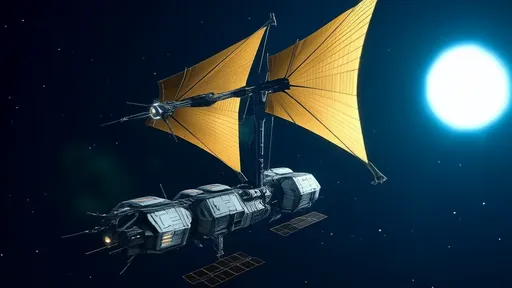
The principle behind solar sails is deceptively simple. Photons, though massless, carry momentum. When they reflect off a large, ultrathin sail, they impart a tiny but continuous push. Over time, this accumulated force can propel a spacecraft to remarkable speeds without the need for fuel. Recent advancements in materials science have made it possible to construct sails that are both lightweight and durable, capable of withstanding the harsh conditions of space while maximizing the efficiency of photon propulsion.
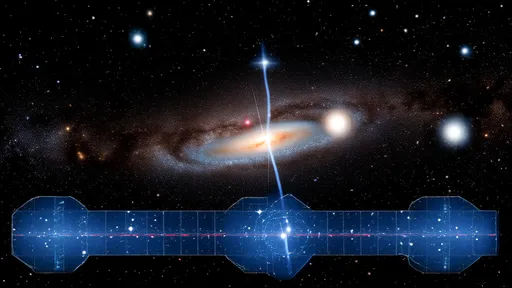
One of the most compelling applications of this technology is the Solar Sail Interstellar Express, a proposed network of cargo vessels designed to transport supplies between Earth, Mars, and the outer planets. These vessels would operate on predictable schedules, much like terrestrial freight trains, but with the added advantage of requiring no fuel once deployed. Cargo pods could be attached to modular sail arrays, allowing for flexible payload configurations depending on mission requirements.
The Environmental and Economic Advantages
Traditional space missions are burdened by the tyranny of the rocket equation, which dictates that a significant portion of a spacecraft’s mass must be dedicated to fuel. This constraint not only limits payload capacity but also drives up costs exponentially. Solar sails circumvent this problem entirely. By eliminating the need for onboard propellant, they drastically reduce launch mass and, consequently, launch expenses. This could make space commerce accessible to a broader range of industries, from mining asteroids to supplying off-world colonies.
Moreover, solar sails are inherently clean. They produce no exhaust, emit no greenhouse gases, and leave no debris in their wake. In an era where sustainability is a growing concern even beyond Earth, this eco-friendly approach to space travel aligns with global efforts to minimize humanity’s environmental footprint. The long-term vision is a solar system where goods are moved silently and efficiently, powered by nothing more than the light of the sun.
Technical Challenges and Breakthroughs
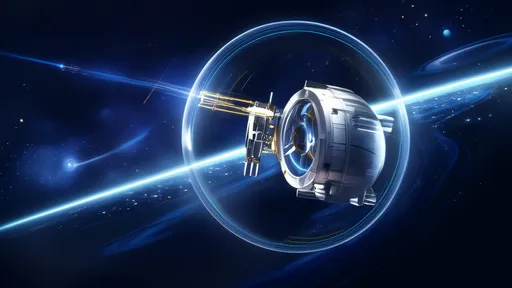
Despite their promise, solar sails are not without challenges. One of the most significant hurdles is the rapid attenuation of sunlight as a spacecraft ventures farther from the sun. Beyond the orbit of Mars, the pressure of photons becomes too weak to provide meaningful acceleration. To address this, engineers are exploring hybrid systems that combine solar sails with laser propulsion. Ground-based or orbital lasers could beam concentrated light onto distant sails, providing the necessary push even in the outer solar system.
Another critical issue is sail durability. Micrometeoroids and space dust pose a constant threat, capable of puncturing the delicate sail material. Researchers are experimenting with self-healing polymers and redundant sail designs to mitigate this risk. Early tests have shown promising results, with some materials capable of autonomously repairing small tears caused by impacts.
The Future of Interstellar Trade
Looking ahead, the Solar Sail Interstellar Express could lay the groundwork for an entirely new economy in space. Imagine a future where water mined from the moons of Jupiter is shipped to thirsty Mars colonies, or where rare metals extracted from the asteroid belt are delivered to Earth-orbiting factories—all without a single drop of rocket fuel. The scalability of solar sails means that as demand grows, so too can the fleet, with larger sails and more sophisticated navigation systems enabling faster and more reliable deliveries.
Perhaps the most exciting prospect is the potential for interstellar missions. While current solar sail technology is best suited for travel within our solar system, theoretical designs involving gigawatt-powered lasers could one day propel sails to nearby stars. The same principles that enable cargo runs between planets might eventually facilitate the first human missions to Proxima Centauri or beyond.
As we stand on the cusp of this new era, the Solar Sail Interstellar Express represents more than just a novel way to move goods—it symbolizes humanity’s enduring ingenuity and our relentless drive to explore the unknown. The stars have always called to us, and now, with the power of light at our backs, we may finally be poised to answer.
By /Jul 18, 2025

By /Jul 18, 2025

By /Jul 18, 2025

By /Jul 18, 2025

By /Jul 18, 2025

By /Jul 18, 2025

By /Jul 18, 2025

By /Jul 18, 2025

By /Jul 18, 2025
By /Jul 18, 2025
By /Jul 18, 2025

By /Jul 18, 2025

By /Jul 18, 2025

By /Jul 18, 2025

By /Jul 18, 2025

By /Jul 18, 2025

By /Jul 18, 2025
By /Jul 18, 2025
By /Jul 18, 2025

By /Jul 18, 2025